 All stories
Rudranath Called Me When My Soul Needed a Restart
Published 27 Jul 2026
Some journeys aren't planned on calendar invites or weekend getaways. They happen because your soul reaches a point where it simply needs a total system restart. That is exactly wh
Some journeys aren't planned on calendar invites or weekend getaways. They happen because your soul reaches a point where it simply needs a total system restart. That is exactly where I was when the call of
Rudranath Dham, the fourth and most secluded Kedar of the Panch Kedar.
If you are looking for a commercial, perfectly paved trail with sunshine and postcard-smooth logistics, this isn’t that story. This is the raw, muddy, leech-infested, foggy, and utterly divine reality of trekking to Rudranath in the peak of the Indian monsoon.
The Journey Begins: Getting to the Basecamp
Our route started from Roorkee, heading toward Karanprayag, We grabbed a shared cab to Karanprayag, switched to a local taxi to Gopeshwar, and finally made our way to Sagar Village, the official basecamp for the trek.
Traveler’s Tip: If you're coming from Dehradun, you can also catch a direct Roadways bus straight to Sagar Village, which saves you multiple cab switches.
My sister was my trek partner for this journey. We stood at the trailhead at 5:00 AM, greeted by a soft monsoon drizzle. The air was cool, fresh, and full of promise. It felt like a dream come true, and our target was clear, reach the shrine in time for the evening Aarti, no matter what.
Then, reality hit us.
Monsoon Realities: Heavy Packs & Unexpected Companions
Within the first hour, we realized our very first mistake: overweighted backpacks. Rain soaked gear makes a heavy bag feel twice as heavy. Thankfully, we had our raincoats, but the real challenge was just beginning.
Locals often say monsoon offers a unique magic for trekking, but they forget to mention two key details:
1. The Fog: Dense, heavy, and persistent enough to completely swallow views at some of the most scenic spots.
2. The Leeches: They were altogether too eager to trek alongside us.
CRUCIAL MONSOON TREK PACKING LIST
• Salt & Turmeric (Removes leeches instantly without tearing your skin)
• Dettol
• Waterproof rain cover for bags
• Sturdy, high-grip trekking boots
If a leech attaches to you, don’t pull it off forcefully, it really hurts and leaves a nasty mark. Sprinkling salt makes them drop off immediately.
Into the Dense Silence of the Forest
After completing our official registration, we stepped into a dense forest stretching for about 3 kilometers. The trail quickly grew steep and punishing. In the thick fog, you couldn't see a single insect, when the mist occasionally cleared, the dark, moody forest revealed itself in all its quiet, ethereal beauty, gushing waterfalls, narrow muddy footpaths, towering mossy rocks, and slick green grass.
There were no wooden signs or arrows pointing the way through the jungle. At times, we were convinced we had taken a wrong turn, but subtle human markers guided us: footprints in the mud, tiny bits of discarded trash, and the sound of flowing water.
Trek Timeline: Day 1
• 05:00 AM — Started from Sagar Village
• 10:30 AM — Reached Pung Bugyal (First Major Stop)
• 12:30 PM — Reached Panar Bugyal (Second Major Stop)
• 01:30 PM — Reached Lyuti Bugyal (Decision Point)
• 07:30 PM — Arrived at Rudranath Temple for Evening Aarti
By 10:30 AM, we finally broke out of the dense trees and reached Pung Bugyal—our first stop. The view was breathtaking enough to make us instantly forget how intimidating the forest had felt. The locals running the small stalls here were incredibly sweet, offering warm tea, guidance, and encouraging words.
Whispering Secrets to the Ancient Trees
From Pung Bugyal, we plunged into the next forest section. This one hit harder. It was darker, deeper, and profoundly silent, carved up by roaring mountain streams. But here, we began running into fellow pilgrims, trekkers, and locals. The anxiety of getting lost drifted away.
I’ve always believed in talking to nature. There’s an old belief that if you whisper your secrets to ancient forest trees, they hold them for you. Walking through those woods, surrounded by towering trunks and uniquely shaped mossy boulders, I felt like I was surrounded by old, silent friends.
By 12:30 PM, we reached Panar Bugyal. We stopped for a quick meal (though my toes ended up being a meal for the local leeches instead—shoutout to the kind trekker who threw salt on my feets).
Human Snails & The Final Push
By 1:30 PM, we made it to Lyuti Bugyal. The forest officers stationed there gave us a realistic check
> "If you reach Lyuti by 2:00 PM, you can push for the summit today. But know this: it's not typically a one-day trek. Many people break it down into 2 or 3 days because of the steep gradient. You guys are moving slow."
They weren't wrong—we were essentially human snails on that slope. But it was only 1:30 PM. What were we going to do sitting at a campsite for the rest of the day?
We made a strategic decision: we left our heavy main rucksacks behind at Lyuti, packed a single light daypack with our absolute essentials, and pushed forward. We were also joined by the ultimate trek buddy—a stray black mountain dog who silently escorted us up the trail.
Beyond Lyuti, the landscape shifted dramatically. The dense trees disappeared, replaced by endless, steep stone climbs that seemed to stretch into the clouds.
Pitradhar & The First Sounds of Divinity
When we finally reached Pitradhar, the ridge opened up into high-altitude alpine meadows (Bugyals). Blankets of wild, colorful mountains, flowers,varieties I had never seen in my life, covered the slopes. Horses and wild goats grazed peacefully against the backdrop of shifting mist.
And then, through the silence of the high valley, we heard it:
The distant, deep echo of blowing Shankh, the rhythm of the Hudka and temple bells.
We didn't walk the rest of the way, we practically ran.
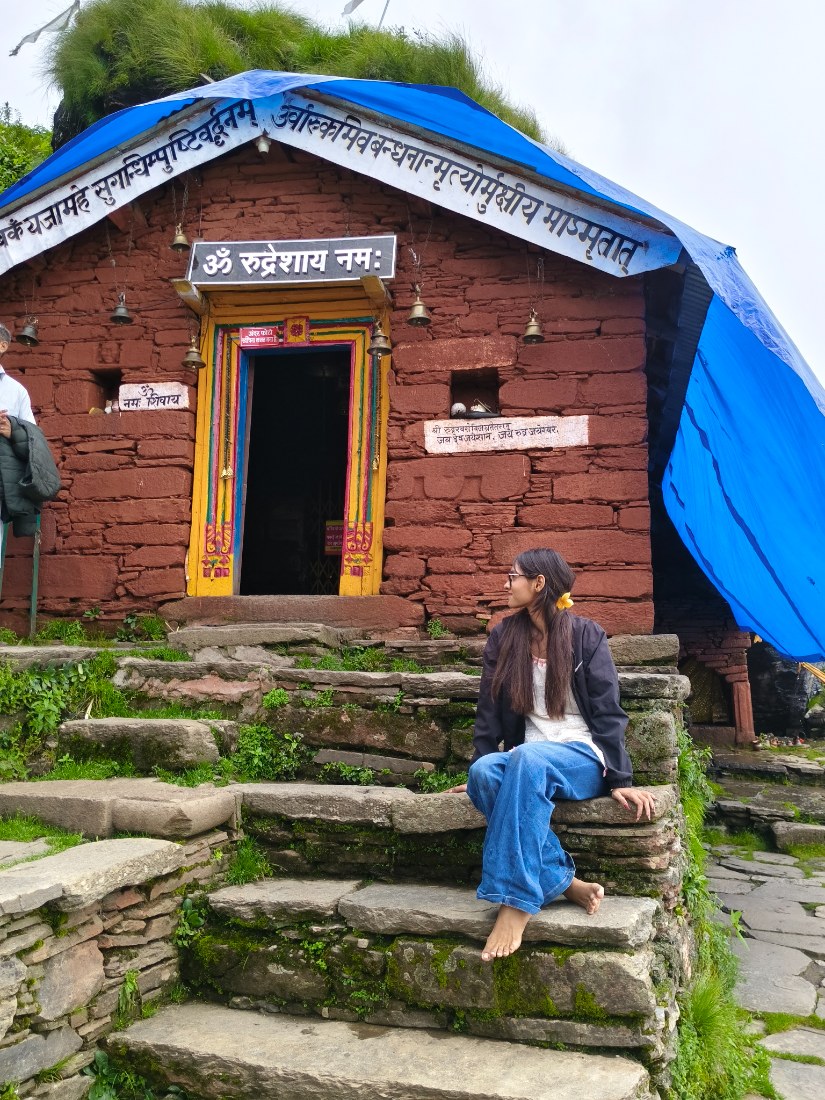
At 7:30 PM, exhausted, soaked, and aching in every muscle, we stood before the shrine of Rudranath Dham right as the evening Aarti began. Hearing those chants resonate across the raw mountain peak washed away every drop of fatigue. The struggle wasn't just worth it;
it was necessary.
A Warm Heart in Cold Winds
It was freezing at the top, a January-like chill in the middle of monsoon. To make matters worse, my clothes were completely soaked from the rain. Noticing me shivering, a local shopkeeper near the temple handed me his own heavy winter jacket without a second thought.
That genuine, simple warmth from strangers is something you only find deep in the Himalayas.
We stayed overnight in a basic shelter near the temple, listening to the rain beat against the roof.
The Face of Shiva & The Fairytale of Saraswati Kund
The next morning at 5:00 AM, torrential rain gave way to a dense, mystical fog. As the sun rose, the mist began to peel back, revealing a landscape so vivid and green it looked completely surreal. No camera lens or phone filter could ever reproduce the natural depth of those colors.
We attended the morning Aarti and Bhajan Sabha, after which we were allowed inside the inner sanctum.
In Rudranath, Lord Shiva is worshipped in his natural rock face avatar (Ekanana). Standing inches away, looking upon that serene face carved by nature and centuries of devotion, is a memory that gets permanently etched into your soul.
After the temple, we made the trek to Saraswati Kund. The setting was pure magic, crystal waters surrounded by misty peaks. It looked like a page ripped straight out of a fairytale (I honestly regretted not packing a flowy floral dress just for a photo moment there!).
The Descent: Bears, Rain, and 2,000 Falls
At 11:30 AM, we began our long descent back toward Sagar Village. If you think going down is easier than coming up, high-altitude monsoon mud will quickly correct that assumption.
Near Pitradhar, a group of fellow trekkers ahead of us suddenly started shouting frantically. When we caught up, they were visibly shaken: a Himalayan bear had just charged toward them.
Fortunately, dense bushes trapped the bear's momentum, and the loud shouting from the group scared it off into the valley below. However, a woman in their group sustained minor injuries during the chaos. Given the danger of the dark, dense forest and the presence of wildlife, all of us decided to stick closely together as one large group for safety.
The descent turned into a slow, grueling test:
The rain poured relentlessly all afternoon.
The forest trail turned pitch black under the heavy canopy.
Being naturally clumsy, I think I fell down literally 2,000 times in the slick mud.
At 11:30 PM—12 hours after starting our descent—we finally limped into Sagar Village and checked into Pinaki Homestay.
The warmth of the family running Pinaki Homestay was unforgettable. They cooked us a hot, simple meal that tasted like pure comfort, and as it turned out, they were the very same kind souls who had pre-arranged our mountain stay up at the temple for us.
Final Thoughts
They say that you don't go to Rudranath because you planned a trip, you go because the mountain calls you when you need it most.
My body eventually made it back to the noise and routines of the city, but a piece of my soul is still up there somewhere between the muddy forest paths, the leech-covered boots, the fog of Lyuti Bugyal, and the divine ring of the temple bells at 7:30 PM.
No approved comments yet. Be the first to leave a thoughtful note.